
Local travel guide
Laguna Nichupté: The Other Side of Cancun Most Visitors Miss
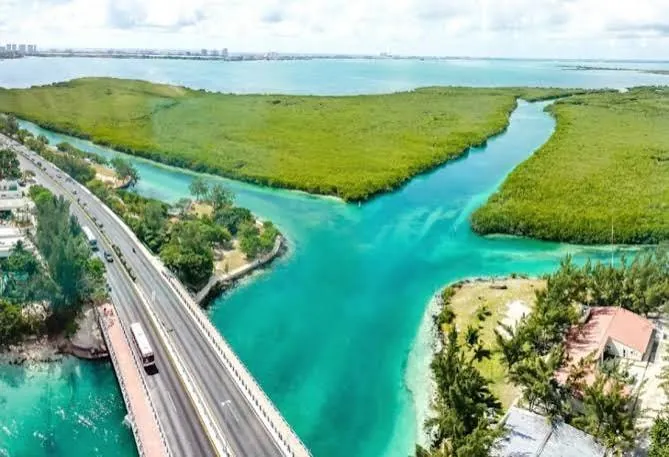
Most travelers know Cancun for its beaches, but Laguna Nichupté reveals a different side of the city: mangroves, channels, sunsets, water activities and the new bridge behind the Hotel Zone.
# Laguna Nichupté: The Other Side of Cancun Most Visitors Miss
When most people picture Cancun, they see the Caribbean side first: white sand, turquoise water and the long line of resorts facing the sea.
Turn around, and the destination changes.
Behind much of the Hotel Zone is Laguna Nichupté, a connected system of lagoons, channels, mangroves and open water. Travelers drive beside it, cross it, eat near it and watch the sun set over it—often without realizing how much it shapes Cancun.
Watch Cancun's other side
Watch the Laguna Nichupté Short on YouTube
The video moves from aerial views to mangrove channels, water activities, the Hotel Zone and the new bridge. It is a quick look at the side of Cancun that exists behind the familiar beaches.
What is Laguna Nichupté?
Laguna Nichupté is not one small lake. Federal documents describe the larger lagoon system as five principal connected bodies of water: Laguna Bojórquez, the northern, central and southern portions of Laguna Nichupté, and Laguna del Inglés. Channels connect the system internally and link it with the Caribbean through Canal Cancún in the north and Canal Nizuc in the south.
That geography explains Cancun's unusual shape. Much of the Hotel Zone sits on a narrow strip of land with the Caribbean on one side and the lagoon system on the other.
The ocean side feels bright, open and energetic. The lagoon side is greener, more reflective and often quieter to look at—although boats, traffic, restaurants and water activities are also part of the modern landscape.
The mangroves are living infrastructure
The mangroves connected with Nichupté are more than scenery. The federal Manglares de Nichupté protected area preserves an urban mangrove and wetland system linked to the lagoon and nearby marine habitats. It is also recognized as Ramsar Site 1777, a wetland of international importance.
Mangroves provide nursery habitat for fish and other aquatic species, support birds and wildlife, help filter water, and reduce the effects of storms and flooding. For travelers, that means the lagoon should be treated as a living ecosystem—not an empty backdrop behind the resorts.
Why the lagoon sunset feels different
Cancun's beach side is famous for sunrise. On the lagoon side, the main show often happens at the end of the day.
As the sun moves toward the mainland, light stretches across the water and turns boats, bridges, mangrove edges and the skyline into silhouettes. Some evenings are dramatic; others are softened by clouds, rain or haze. There is no guaranteed perfect sunset, but the lagoon offers a completely different perspective from the beach.
Use established public-facing areas, businesses or authorized excursions. Do not stop beside fast traffic, enter restricted mangroves or cross private property for a photograph.
The new Nichupté Bridge
The lagoon's transportation role changed again in 2026. The Puente Vehicular Nichupté was officially inaugurated on May 2, 2026, and regular vehicle operations began on May 6.
Government information describes an 11.2-kilometer project with three traffic lanes—one in each direction and one reversible lane—plus a bidirectional bicycle path. It creates another connection between mainland Cancun and Boulevard Kukulcán in the Hotel Zone.
The bridge is now part of the lagoon landscape, but it also highlights the difficult balance between mobility, tourism growth and environmental protection. Construction agencies reported environmental monitoring, restoration work and methods intended to reduce interference with sensitive habitat.
Traffic patterns, operating hours and access rules can change, so travelers should check current local information before relying on the bridge for a time-sensitive airport or tour connection.
Ways to experience the lagoon responsibly
You do not need to enter sensitive mangrove habitat to appreciate Laguna Nichupté.
- Watch sunset from a safe, established lagoon-facing location.
- Choose an authorized kayak, boat or water-activity operator.
- View the system from developed areas and designated routes.
- Keep food, trash and plastics out of the water.
- Never feed, touch or closely approach wildlife.
- Confirm weather, wind and cancellation rules before an excursion.
Can you swim in Laguna Nichupté?
Do not treat the lagoon like a general public swimming beach. Conditions vary by location and may include boat traffic, currents, wildlife, water-quality concerns, private property and restricted access. Use only places and activities specifically designated by an authorized operator.
The Cancun beyond the beach
Laguna Nichupté is not a replacement for the Caribbean side, and it is not better or worse.
It is another part of the same destination.
The ocean side offers beaches, waves and bright blue horizons. The lagoon side offers mangroves, channels, reflected light, city views and a reminder that Cancun was built beside a complex coastal ecosystem.
Many travelers spend their entire vacation close to Laguna Nichupté without stopping to understand what they are seeing.
Sometimes discovering a destination does not require going farther.
Sometimes it only requires turning around.