
Local travel guide
Chichén Itzá History and Architecture: A First-Time Visitor’s Guide
Understand what you are seeing at Chichén Itzá without turning legends into verified history. This first-time guide introduces the city’s long development, major structures, Maya and central Mexican influences, carved imagery and questions archaeologists continue to study.
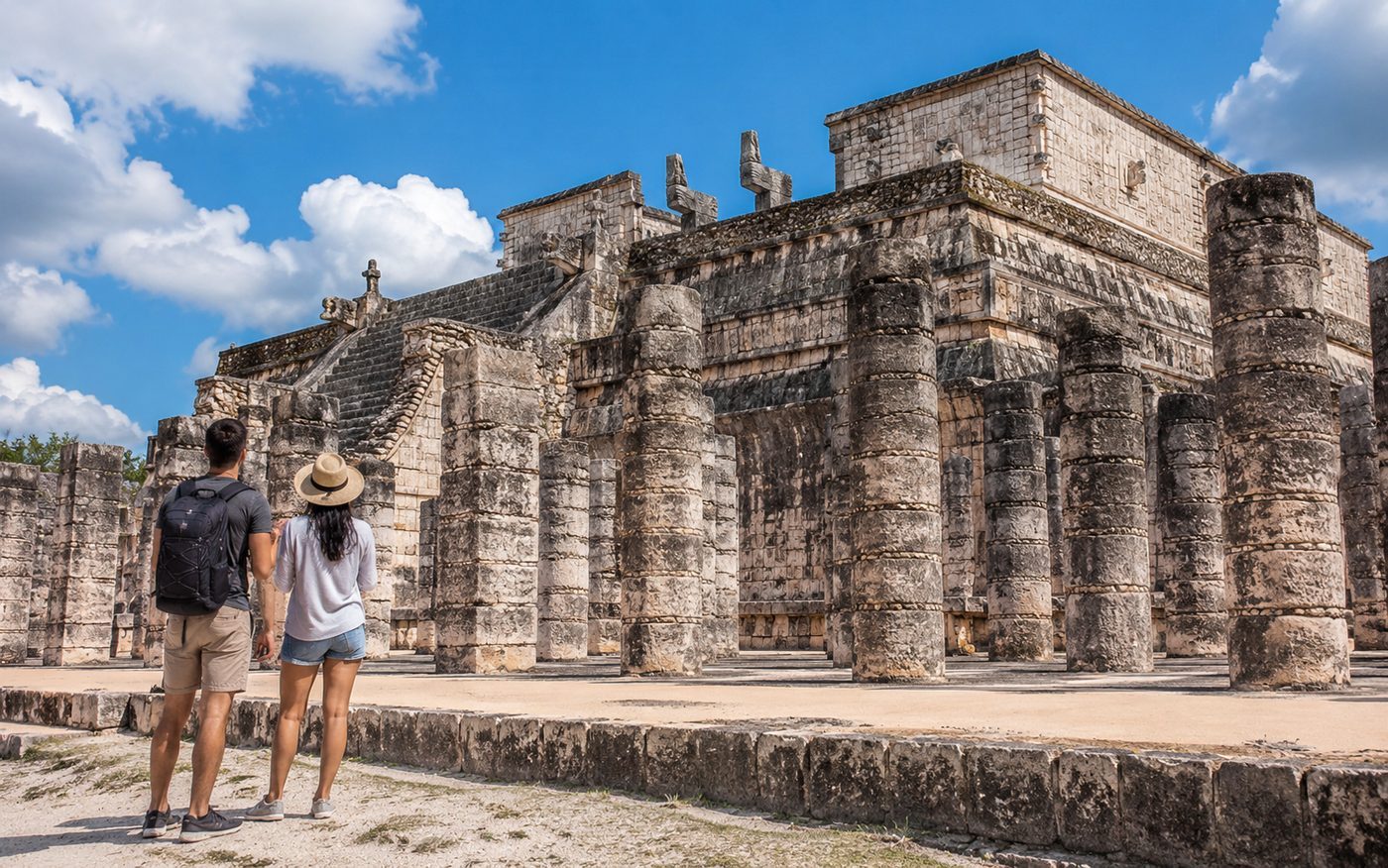
Start with the city, not only the pyramid
El Castillo is the visual center for most visitors, but the surrounding spaces explain more of Chichén Itzá:
- Great Ball Court
- Temple of the Warriors
- Rows of columns
- Sacred Cenote route
- El Caracol
- Las Monjas
- La Iglesia
- Residential and ceremonial relationships
Walk far enough to see how the architecture changes.
A long development
INAH gives a broad chronology extending from approximately the sixth century through the early thirteenth century, with a principal period in the Early Postclassic.
That broad range matters. Buildings were constructed, modified, reused and interpreted over generations.
Avoid statements such as “Chichén Itzá was built in the year…” as if the entire city appeared at once.
Maya and central Mexican connections
UNESCO and INAH both describe architectural and artistic features that connect Chichén Itzá with broader Mesoamerican movements and central Mexican traditions.
Scholars have debated:
- Migration
- Trade
- Political alliance
- Warfare
- Shared religious imagery
- Local adoption of outside styles
A simple “the Toltecs conquered the Maya” story is not the only interpretation and should not be presented as settled fact without context.
El Castillo
Observe:
- Stepped terraces
- Four stairways
- Temple at the summit
- Serpent-head sculptures
- Relationship to the open plaza
The building is commonly called the Temple of Kukulcán.
Popular explanations often connect every stair, panel or shadow with one complete calendar system. Some numerical observations are real, but the interpretation of intentional design can be more complicated than a tour slogan suggests.
Climbing is prohibited. Study the building from the designated visitor areas.
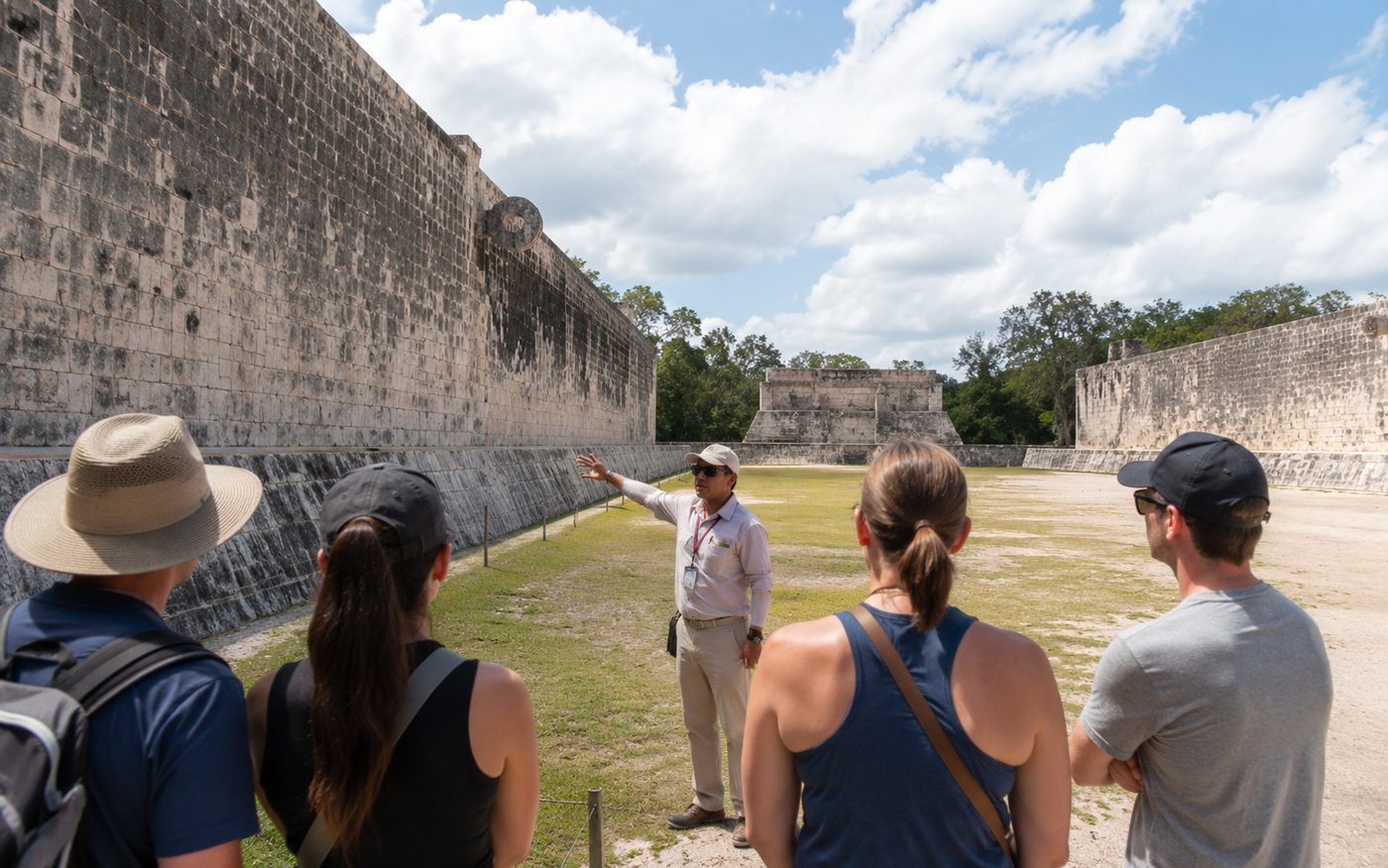
Great Ball Court
The Great Ball Court is striking because of its scale and high parallel walls.
Look for:
- Stone rings
- Relief panels
- Temple structures
- Acoustics
- Movement through the space
Ballgames in Mesoamerica had social, political and ritual importance. They were not identical in every place or period.
Reliefs at Chichén Itzá include violent imagery, but that does not prove that every player, captain or winner was sacrificed after every game.
Temple of the Warriors and columns
The Temple of the Warriors and surrounding columns create a large architectural complex.
Notice:
- Repeated columns
- Carved figures
- Processional feeling
- Relationship to El Castillo
- Elevated temple platform
The modern name suggests warfare, but structure names assigned by archaeologists or later visitors do not always reveal the building’s full original purpose.
Sacred Cenote
The Sacred Cenote is not a recreational swimming stop.
It was part of the city’s ritual landscape and has produced important archaeological materials. Cenotes also had practical importance in the limestone environment of northern Yucatán.
The path helps visitors understand that the city’s layout relates to water and landscape, not only monuments.
El Caracol
El Caracol is notable for its circular upper form.
It is widely associated with astronomical observation because researchers have studied orientations and sightlines. A careful description is:
- The form is unusual.
- Astronomical interpretations are important.
- Not every claimed alignment is equally accepted.
- The building may have had multiple functions over time.
Las Monjas and La Iglesia
These are Spanish names given long after the buildings were used.
“Las Monjas” does not mean the complex housed nuns in the pre-Hispanic period. “La Iglesia” does not mean it was a Christian church.
Look at:
- Room arrangements
- Decorated façades
- Masks and repeated motifs
- Differences from the northern plaza
These structures are a strong reason to continue beyond El Castillo.
Equinox light and shadow
INAH describes the famous pattern of triangular light and shadow on El Castillo around the equinox period.
The visual effect is observable. Claims about its exact intended date, meaning and precision should be separated from the observation itself.
A responsible explanation can say:
- The building’s orientation produces a notable seasonal effect.
- Maya architecture incorporated astronomical knowledge.
- Scholars discuss intentionality and interpretation in detail.
- Modern crowds and tourism have shaped how the event is experienced.
Human remains, sacrifice and dramatic stories
Ritual sacrifice was part of some Mesoamerican contexts, and archaeological evidence at Chichén Itzá is important.
However, responsible interpretation avoids:
- Sensational numbers without sources
- Claiming one rule for all ballgames
- Describing every cenote deposit with the same explanation
- Turning later legends into eyewitness history
Ask which excavation, inscription or object supports the claim.
Names and translation
INAH explains Chichén Itzá as “the city at the edge of the well of the Itzáes.” Translations can vary in wording because Maya-language terms are represented in different orthographies.
Use accent marks in Spanish writing: Chichén Itzá.
How to use a guide
Ask:
- What is directly visible?
- What was found archaeologically?
- Which interpretation is widely accepted?
- What remains debated?
- Is the modern building name original?
A good guide does not need to erase uncertainty.
Google Maps
- Archaeological site: https://www.google.com/maps/search/?api=1&query=Chichen+Itza+Archaeological+Site
- Sacred Cenote: https://www.google.com/maps/search/?api=1&query=Sacred+Cenote+Chichen+Itza
- Gran Museo: https://www.google.com/maps/search/?api=1&query=Gran+Museo+de+Chichen+Itza
The map helps with orientation but should not replace official barriers or current routes.
Accidental Gringo tips
- Photograph relationships between buildings, not only individual façades.
- Read the UNESCO description before visiting.
- Spend time in the southern group.
- Ask for the evidence behind dramatic claims.
- Use the museum to add object-based context.
- Respect modern Maya communities as living people, not only historical subjects.
Common mistakes
- Treating the city as one construction project.
- Repeating every tour legend as fact.
- Leaving after photographing El Castillo.
Frequently asked questions
Was Chichén Itzá Maya or Toltec?
It was a Maya city with important architectural and artistic connections to central Mexico. Scholars debate how those relationships developed.
Is every feature of El Castillo a calendar?
No. Some patterns have calendrical interpretations, but popular claims often simplify complex architectural evidence.
Was El Caracol an observatory?
Astronomical interpretation is important, but it is safer to describe the evidence and uncertainty than claim one exclusive proven function.
Why are buildings called Las Monjas and La Iglesia?
Those are later Spanish names and do not prove the original Maya use of the buildings.
Verification notes
Last reviewed: July 14, 2026
The stable planning guidance in this article is based primarily on official INAH and UNESCO information. Admission prices, opening hours, special-event procedures, guide availability, transportation schedules, parking arrangements and temporary access restrictions can change.
Check the official sources again shortly before publication and before travel:
- INAH Chichén Itzá visitor page: https://www.inah.gob.mx/zonas/146-zona-arqueologica-de-chichen-itza
- Lugares INAH Chichén Itzá services and rules: https://lugares.inah.gob.mx/en/node/5663
- Government of Yucatán Boleto Único announcement: https://www.yucatan.gob.mx/saladeprensa/ver_nota.php?id=10762
- UNESCO World Heritage listing: https://whc.unesco.org/en/list/483/
Needs Review before future publication updates: Any exact price, schedule, transportation departure, parking fee, authorized-guide rate, special-event access procedure, temporary closure or route restriction.