
Local travel guide
Chichén Itzá Accessibility and Mobility Guide
Plan a Chichén Itzá visit with a wheelchair, cane, walker or limited stamina. This guide covers transportation, outdoor surfaces, route choices, heat, restrooms, guides, the visitor center and questions to verify before travel.
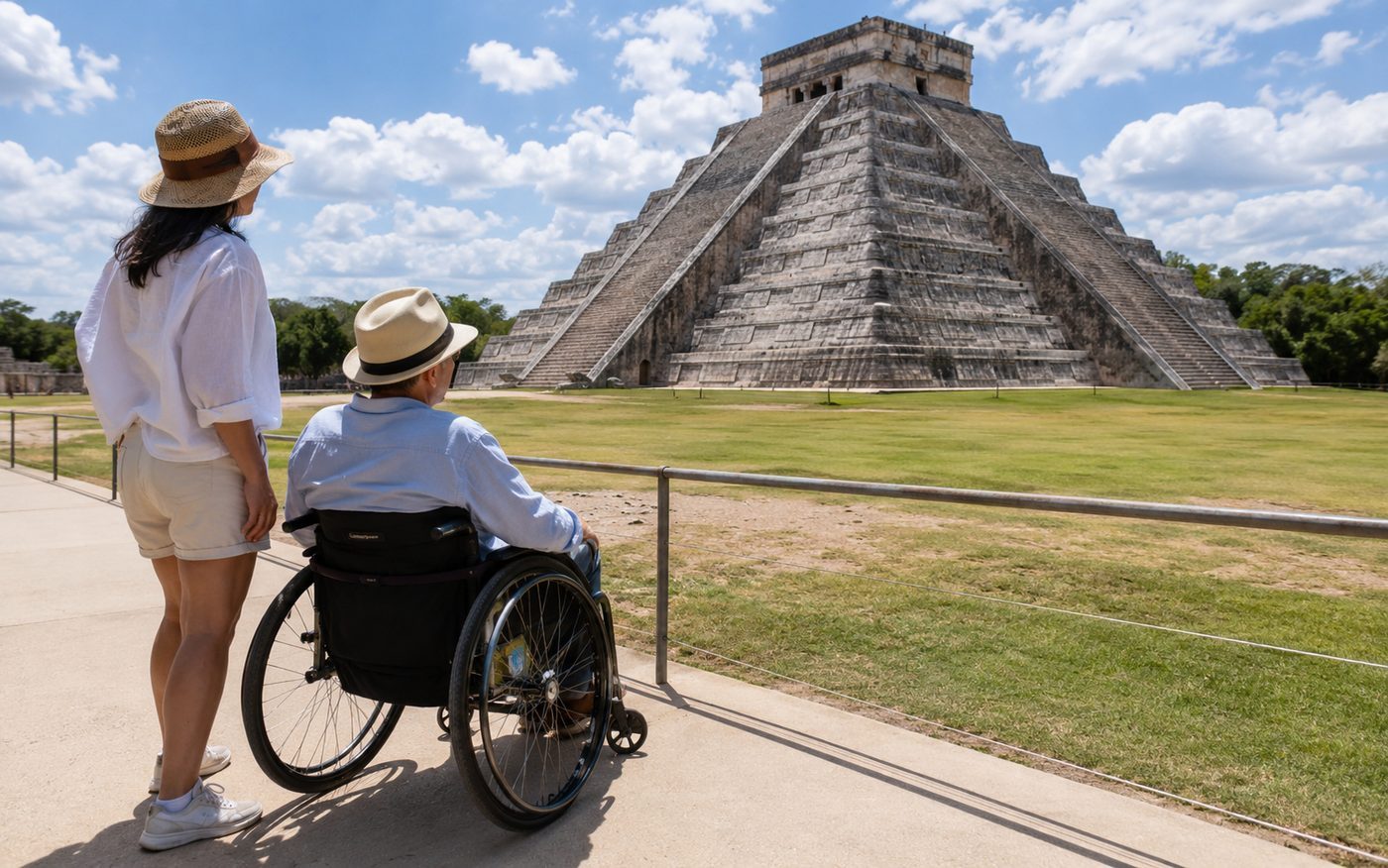
What “accessible” should mean in planning
An accessibility symbol does not answer every traveler’s questions.
A useful assessment includes:
- Step-free arrival
- Distance from vehicle to entrance
- Ticket-counter height and queue
- Surface firmness
- Path width
- Rest areas
- Restrooms
- Heat exposure
- Mobility-device storage
- Companion assistance
- Emergency exit
Needs vary among manual wheelchair users, power-chair users, cane users, people with balance conditions and travelers who can walk short distances but not the full route.
Contact before travel
Use the official INAH contact information and ask specific questions.
Examples:
- Which entrance should we use?
- Is there a current accessible route to the main plaza?
- Are ramps operating?
- Are wheelchairs available for loan or rent?
- What surfaces are present?
- How far is the restroom from the route?
- Can a vehicle approach the entrance?
- Are any routes closed for conservation?
Record the date and source of the answer because conditions can change.
Transportation
The vehicle may be the most important accessibility decision.
Confirm:
- Exact model or configuration
- Door width
- Step height
- Ramp or lift
- Wheelchair securement
- Passenger transfer method
- Storage dimensions
- Number of companions
- Air conditioning
- Rest stops
- Waiting time
A large van is not automatically accessible. A vehicle that can store a folded chair may not accommodate a passenger remaining seated in it.
Organized tours
Ask whether the tour can adapt:
- Hotel pickup
- Boarding
- Group walking pace
- Guide route
- Lunch access
- Cenote stairs
- Return time
A standard group tour may state that it accepts wheelchairs while still using a cenote or restaurant with steps. Verify every stop, not only Chichén Itzá.
Private transportation and guide
A private arrangement often provides more time and route flexibility.
Ask the guide to prioritize:
- El Castillo exterior
- Great Ball Court entrance and views
- Temple of the Warriors
- Areas reachable without excessive distance
The visitor should not have to prove endurance to receive a meaningful experience.
Main plaza
The main plaza contains the site’s most recognizable architecture and broad open areas. It is a logical first priority.
Heat and sun remain important. An open surface may be physically accessible while still difficult because of exposure and distance.
Sacred Cenote path
The Sacred Cenote is culturally important, but the path adds distance. Treat it as optional based on:
- Surface condition
- Heat
- Device wheels
- Available assistance
- Return energy
A traveler does not have an incomplete visit by skipping one outlying area.
Southern group
El Caracol, Las Monjas and La Iglesia add architectural variety. They also extend the route.
Decide before entering whether they are:
- Essential
- Optional if energy remains
- Replaced by museum time
Wheelchairs and wheels
Outdoor-capable larger wheels generally handle rough surfaces better than small transport-chair casters.
Carry any normally needed:
- Tire repair item
- Cushion
- Charger
- Spare battery
- Rain cover
- Transfer aid
Do not test unfamiliar equipment for the first time on a long regional trip.
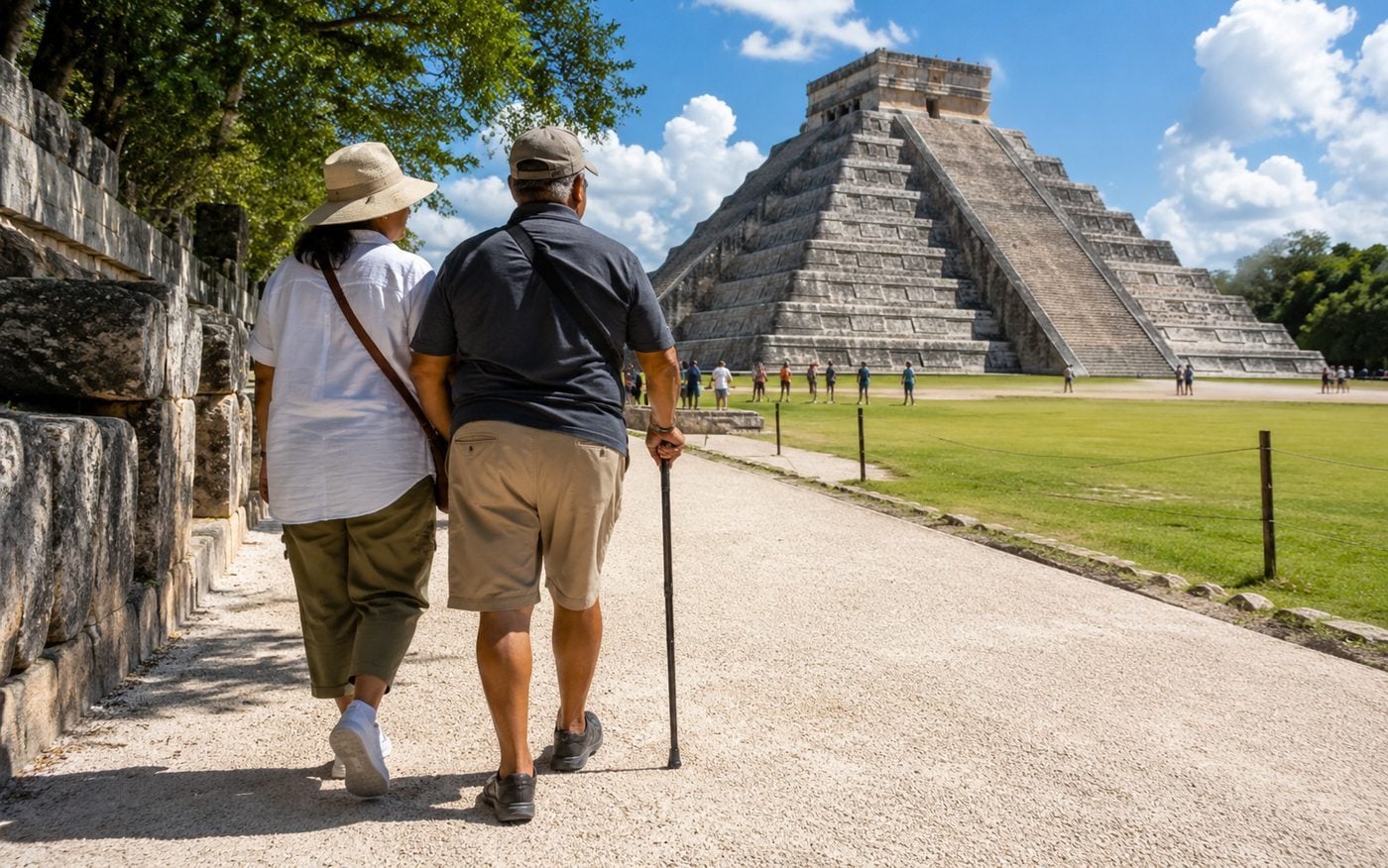
Canes and walkers
Travelers using canes or walkers should consider:
- Stable rubber tips
- Rest opportunities
- A folding seat if normally used and permitted
- A companion for rough sections
- Avoiding peak heat
A walker that is comfortable indoors may behave differently on stone or compacted outdoor paths.
Heat and medical planning
Limited mobility can increase time in the sun.
Bring:
- Water
- Hat
- Medication
- Cooling strategy normally used
- Emergency information
- Flexible exit plan
Do not leave medication or batteries in a hot parked vehicle.
Restrooms and visitor services
INAH lists restrooms, parking, cloakroom, information and accessibility services. The Gran Museo page also lists accessibility and restrooms.
Confirm:
- Current restroom location
- Stall configuration
- Path from entrance
- Whether the museum is open
- Whether museum entry is included under current ticket procedures
Museum as an alternative or addition
The Gran Museo de Chichén Itzá can add context in a more controlled environment. Current INAH information lists daily hours of 8:00 a.m. to 5:00 p.m. and states that entry is included with archaeological-zone admission.
Operations can change, so verify the museum on the day of travel.
Adding Valladolid or a cenote
Accessibility must be checked separately.
A cenote may involve:
- Steep stairs
- Wet surfaces
- Narrow entry
- Limited changing access
- No lift
Valladolid may include uneven sidewalks, curbs and heat. A shorter meal stop may be better than a long walking route.
Google Maps
- Visitor center: https://www.google.com/maps/search/?api=1&query=Centro+de+Atencion+a+Visitantes+Chichen+Itza
- Archaeological site: https://www.google.com/maps/search/?api=1&query=Chichen+Itza+Archaeological+Site
- Gran Museo: https://www.google.com/maps/search/?api=1&query=Gran+Museo+de+Chichen+Itza
Use satellite view only as a planning aid. It cannot confirm current barriers or surface condition.
Accidental Gringo tips
- Ask specific questions instead of “Is it accessible?”
- Photograph the mobility device before loading it.
- Carry repair contact information.
- Make the southern group optional.
- Use the museum when heat or surfaces limit the route.
- Give the traveler control over when to stop.
Warnings
Do not describe Chichén Itzá as fully barrier-free based only on a service icon.
Do not assume a cenote included in an accessible tour is independently accessible.
Common mistakes
- Booking a vehicle before discussing equipment dimensions.
- Expecting every path to match the main plaza.
- Combining too many physically uncertain stops.
Frequently asked questions
Is the site wheelchair accessible?
There are accessibility services, but route difficulty varies. Confirm current conditions and prioritize the central area.
Should we hire a private guide?
A private guide can adapt the route and pace, which may provide better value than a standard group tour.
Is the museum useful?
Yes, especially when heat or surface conditions limit outdoor time. Verify current operation and inclusion.
Can we bring a mobility scooter?
Confirm the site’s current equipment rules and the transportation vehicle’s storage or securement before travel.
Verification notes
Last reviewed: July 14, 2026
The stable planning guidance in this article is based primarily on official INAH and UNESCO information. Admission prices, opening hours, special-event procedures, guide availability, transportation schedules, parking arrangements and temporary access restrictions can change.
Check the official sources again shortly before publication and before travel:
- INAH Chichén Itzá visitor page: https://www.inah.gob.mx/zonas/146-zona-arqueologica-de-chichen-itza
- Lugares INAH Chichén Itzá services and rules: https://lugares.inah.gob.mx/en/node/5663
- Government of Yucatán Boleto Único announcement: https://www.yucatan.gob.mx/saladeprensa/ver_nota.php?id=10762
- UNESCO World Heritage listing: https://whc.unesco.org/en/list/483/
Needs Review before future publication updates: Any exact price, schedule, transportation departure, parking fee, authorized-guide rate, special-event access procedure, temporary closure or route restriction.
Additional official source: Gran Museo de Chichén Itzá: https://lugares.inah.gob.mx/en/node/6427